
Step-by-step teaching at home
Fall prevention and home safety
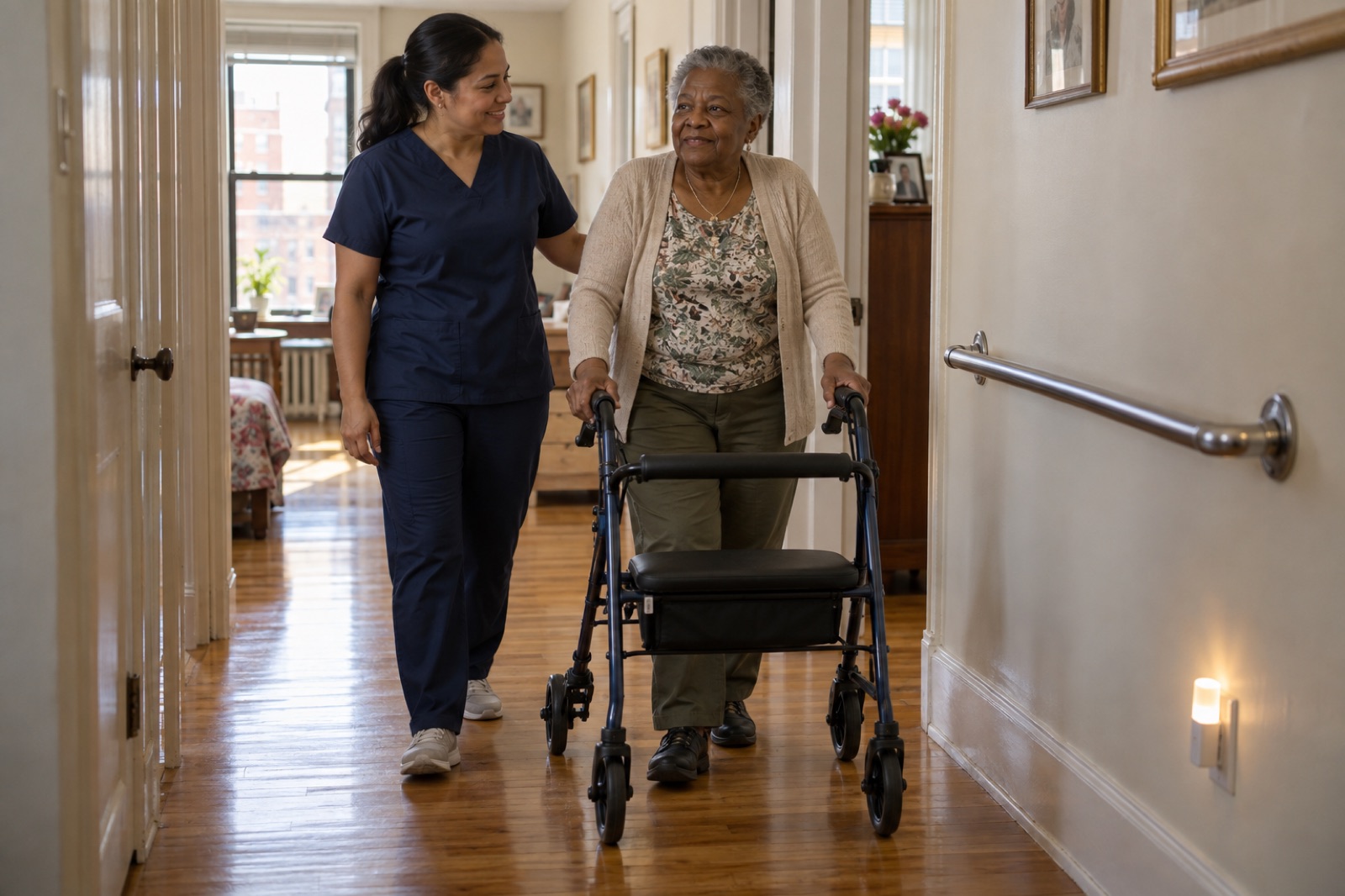
A registered nurse walks through your home with you, room by room, and teaches simple changes and safe movements that help prevent falls.
Fall prevention
Watch how it’s done
Short videos about the equipment and the care — the same steps the nurse goes through with you at the visit. They are from independent YouTube channels (mostly in English); we do not control their content.
- Standard (pick-up) walkerYouTube · RegisteredNurseRNIn our equipment guide →
- Four-wheel rollator (with seat)YouTube · PHYSICALTHERAPY4EVERYONEIn our equipment guide →
- Single-point caneYouTube · Will Harlow – Over-Fifties Specialist PhysioIn our equipment guide →
- Wall-mounted grab barsYouTube · The Handyman JourneyIn our equipment guide →
- Shower chair (with back)YouTube · VHC HealthIn our equipment guide →
- Raised toilet seat with armsYouTube · NOVA Medical ProductsIn our equipment guide →
- Motion-sensor night lightsYouTube · JD The OTIn our equipment guide →
- Medical alert button with fall detectionYouTube · Medical GuardianIn our equipment guide →
Fall prevention
What you will learn
- A room-by-room look at lighting, rugs, cords, stairs and the bathroom
- Where grab bars, a shower chair or a raised toilet seat may help
- Using a walker or cane safely, at the right height
- Getting up from a chair, the bed and the toilet safely
- Safe shoes and slippers
- Medicines that can cause dizziness — questions for your doctor
- What to do after a fall, and how to get up — or call for help
Who it is for
Older adults, people after a fall, a hospital stay or surgery, and families who worry about a parent who lives alone.
Before the visit
Wear your usual shoes and have your walker or cane nearby. A family member who lives with you is welcome to join.
How the visit works
The nurse explains each step, shows it with your own supplies, and watches and coaches you as you practice — over more than one visit if you need it — so you can feel confident doing it safely. You keep written steps in English or Russian.
Is it getting better?
The nurse also checks whether the care at home matches the doctor’s orders and whether things are improving. If not, the nurse points out what may be missing and helps you bring clear questions to the doctor. You pay us directly, not insurance — so the visit is about one thing: the patient’s progress.
Fall prevention
Book this visit
Choose a day and a time — a registered nurse comes to your home, or to the bedside in a hospital, rehab center or nursing home, and teaches it step by step.
Book today First visitPrivate pay — no insurance.
Questions
Questions
Do you sell or install equipment?
No. We teach and suggest; you buy from your pharmacy or supplier. Our equipment guide explains what each device does.
Do you take insurance?
No. Visits are private pay — we do not take or bill insurance. The first visit is $100 (regular price $150), each visit after that is $150, and a 30-minute phone consultation is $50.
Will the nurse do the care for us?
No. The nurse teaches and coaches — the patient, the family or your aide does the care. We teach the care your doctor or nurse practitioner ordered, and we do not replace your doctor, home care agency, supplier or infusion pharmacy.
Other skills we teach
- Wound care
- Urinary catheters
- IV medication
- G-tube & feeding pump
- Tracheostomy care
- Nephrostomy tube
- Insulin & diabetes
- Oxygen, nebulizer & inhalers
- Medication management
- Heart failure, COPD & blood pressure
- Caregiver & aide training
- Coming home from the hospital
- All services on the home page →
Our nurses teach — they do not provide hands-on nursing care, and they do not replace your doctor, home health agency, facility staff or aide. We teach the care your physician or nurse practitioner ordered. We are not a licensed home care services agency or a certified home health agency, and we do not employ or place home health aides. In an emergency, call 911.