
Hands-on teaching at home
Urinary catheter teaching at home
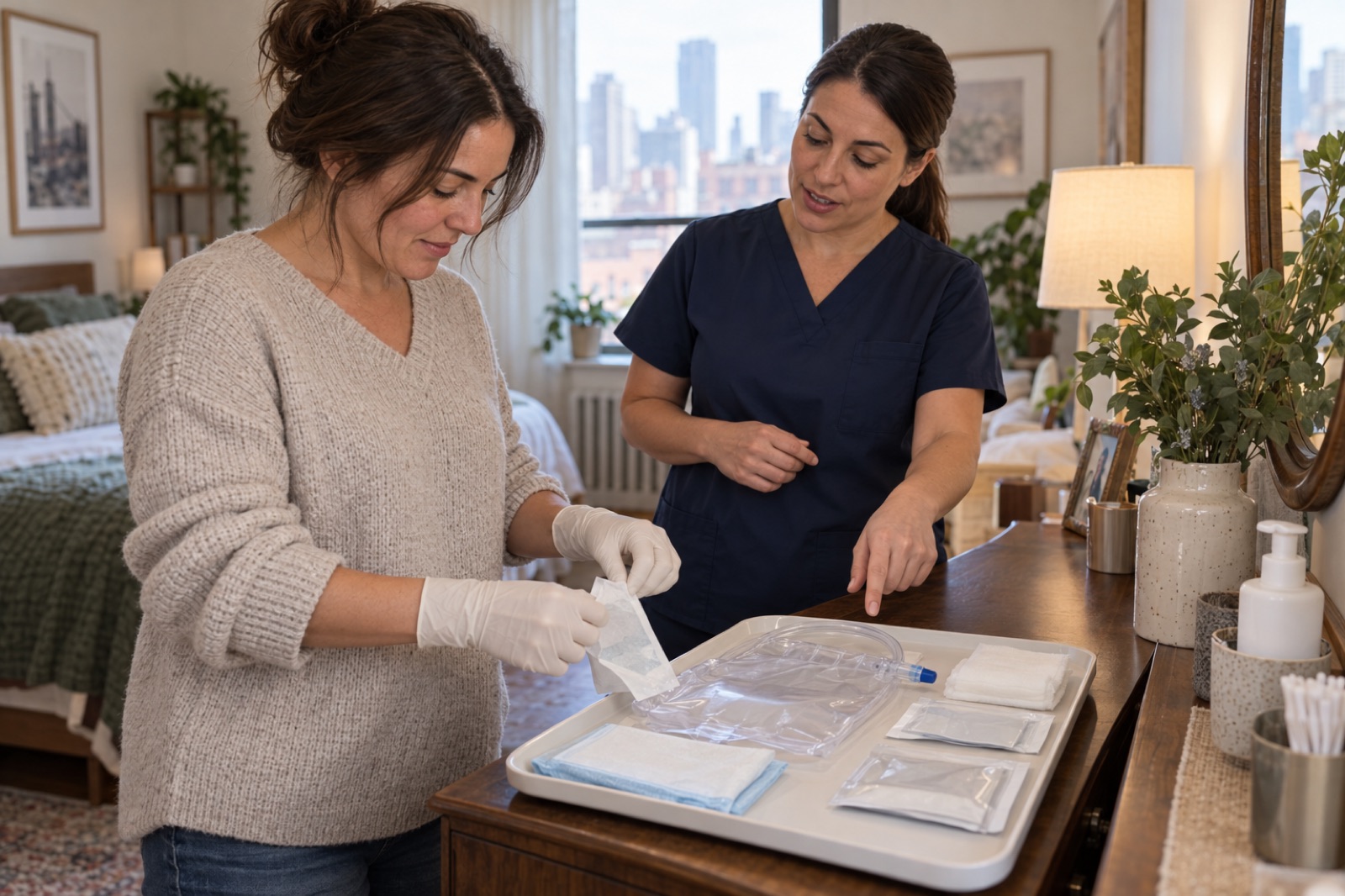
A registered nurse teaches the patient, or the family member who will do it, to insert a straight (in-and-out) or an indwelling (Foley) catheter as your doctor ordered — and to care for any type of urinary catheter every day.
Book today First visitPrivate pay — we do not take insurance, Medicare or Medicaid.
Urinary catheters
What you will learn
- Straight (intermittent, in-and-out) catheterization — by yourself or by a family member, on the schedule your doctor ordered
- Inserting an indwelling (Foley) catheter with sterile technique, and filling the balloon with the amount of sterile water printed on the catheter — when your doctor ordered that the family do it
- Daily care of Foley and suprapubic catheters, and securing the tube to the leg so it does not pull
- Emptying and changing leg bags and night bags, and keeping the bag below the bladder
- External catheters for men and women: fitting, changing and skin care
- Writing down how much urine comes out, when the doctor asked for it
- Preventing infection and blockage: hand washing, cleaning and fluids as allowed
- When to call: fever, pain, blood, cloudy or bad-smelling urine, leaking, or no urine draining
Who it is for
People sent home with a catheter or told to self-catheterize — men and women, after surgery, a spinal cord injury, multiple sclerosis or urinary retention — and the spouse, son, daughter or aide who helps.
Before the visit
Have the doctor’s order (the type and size of catheter, and how often for straight catheterization), and the catheters, lubricant, gloves, cleaning supplies and bags from your pharmacy or supplier. For a Foley insertion the nurse checks that you have a sterile kit.
How the visit works
The nurse explains each step, shows it with your own supplies, and watches and coaches you as you practice — over more than one visit if you need it — so you can feel confident doing it safely. You keep written steps in English or Russian.
Is it getting better?
The nurse also checks whether the care at home matches the doctor’s orders and whether things are improving. If not, the nurse points out what may be missing and helps you bring clear questions to the doctor. You pay us directly, not insurance — so the visit is about one thing: the patient’s progress.
Questions
Questions
Do you teach inserting the catheter, or only daily care?
Both. We teach straight (in-and-out) self-catheterization and catheterization by a family member, and inserting an indwelling Foley catheter when your doctor ordered that it be done at home — plus daily care, bag changes and what to watch for. The patient or family member does the insertion; the nurse teaches and coaches each step.
Do you take insurance, Medicare or Medicaid?
No. Visits are private pay — we do not take or bill insurance, Medicare or Medicaid. The first visit is $100 (regular price $150), each visit after that is $150, and a 30-minute phone consultation is $50.
Will the nurse do the care for us?
No. The nurse teaches and coaches — the patient, the family or your aide does the care. We teach the care your doctor or nurse practitioner ordered, and we do not replace your doctor, home care agency, supplier or infusion pharmacy.
Other skills we teach
- Wound care
- IV medication
- G-tube & feeding pump
- Tracheostomy care
- Nephrostomy tube
- Insulin & diabetes
- Oxygen, nebulizer & inhalers
- Medication management
- Fall prevention
- Heart failure, COPD & blood pressure
- Caregiver & aide training
- Coming home from the hospital
- All services on the home page →
Our nurses teach — they do not provide hands-on nursing care, and they do not replace your doctor, home health agency, facility staff or aide. We teach the care your physician or nurse practitioner ordered. We are not a licensed home care services agency or a Medicare-certified home health agency, and we do not employ or place home health aides. In an emergency, call 911.