
Step-by-step teaching at home
Tracheostomy care training at home
A registered nurse teaches the family members who will care for the trach — suctioning, cleaning, changing the ties and what to do in an emergency — until each step feels routine.
Tracheostomy care
Watch how it’s done
Short videos about the equipment and the care — the same steps the nurse goes through with you at the visit. They are from independent YouTube channels (mostly in English); we do not control their content.
- Trach suctioning & suction cathetersYouTube · Parkland HealthIn our equipment guide →
- Trach tube & inner cannulaYouTube · UCLA HealthIn our equipment guide →
- Stoma care & trach dressingYouTube · Johns Hopkins MedicineIn our equipment guide →
- Trach ties & tube holdersYouTube · UCSF Otolaryngology - Head and Neck SurgeryIn our equipment guide →
- HME (“artificial nose”)YouTube · National Tracheostomy Safety ProjectIn our equipment guide →
- Trach humidification (trach mask or collar)YouTube · Midwest Medical CompaniesIn our equipment guide →
- Speaking valveYouTube · Parkland HealthIn our equipment guide →
- Emergency trach kit (go-bag)YouTube · Hamilton Health SciencesIn our equipment guide →
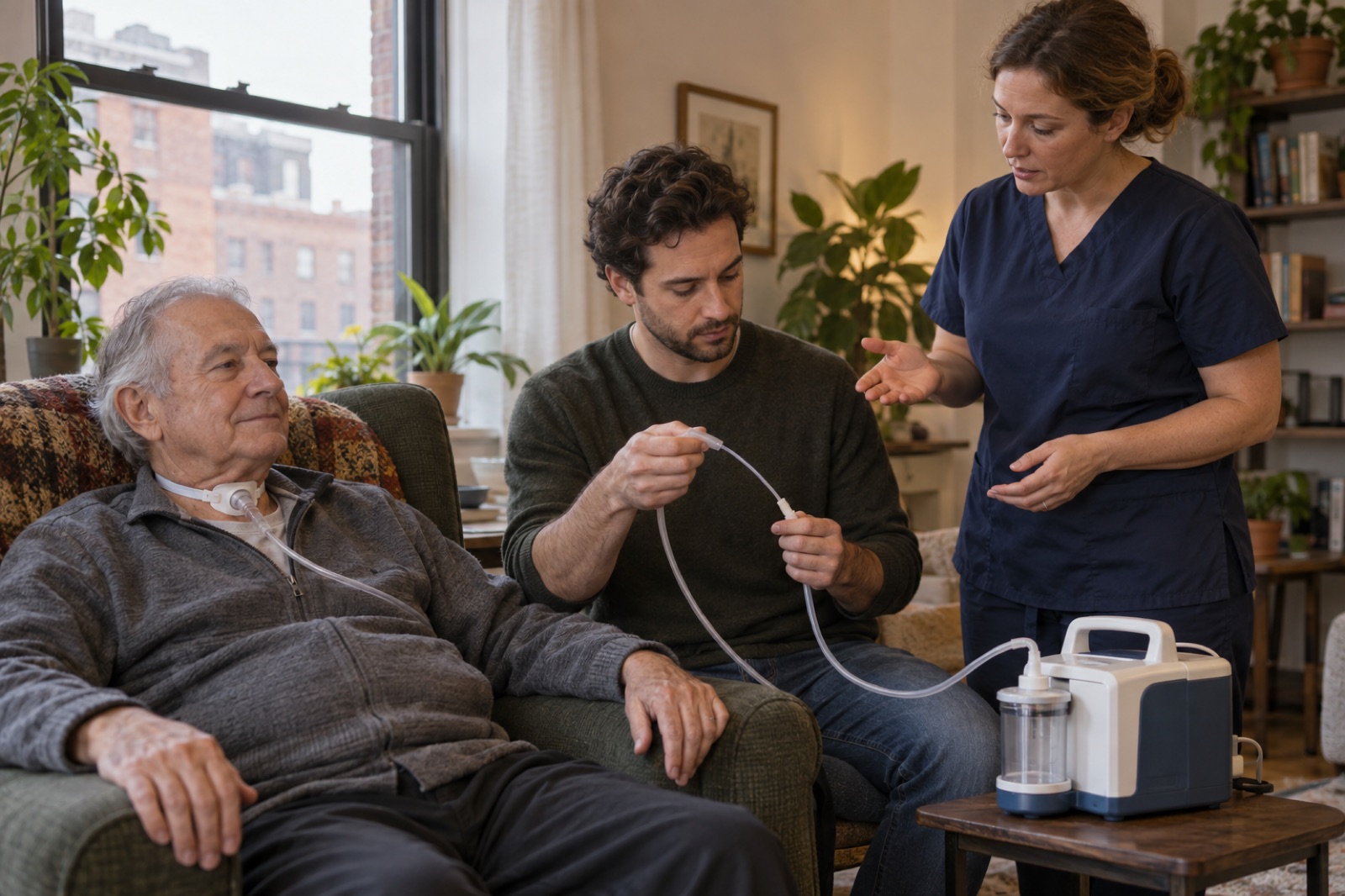
Tracheostomy care
What you will learn
- Suctioning: the depth you were taught, how often, and keeping the suction machine ready
- Cleaning or changing the inner cannula
- Cleaning the stoma and the skin under the plate
- Changing the trach ties safely, with two people
- Humidification: the HME (artificial nose), the trach mask and keeping secretions thin
- The emergency bag: a spare trach and one a size smaller, the obturator, suction — and when to call 911
- Speaking valve care, if one was ordered
- Signs of trouble: hard breathing, blood, a change in secretions, fever
Who it is for
Families and aides caring for someone with a tracheostomy at home.
Before the visit
Have the discharge instructions, the trach type and size, the suction machine and supplies, and the emergency bag.
How the visit works
The nurse explains each step, shows it with your own supplies, and watches and coaches you as you practice — over more than one visit if you need it — so you can feel confident doing it safely. You keep written steps in English or Russian.
Is it getting better?
The nurse also checks whether the care at home matches the doctor’s orders and whether things are improving. If not, the nurse points out what may be missing and helps you bring clear questions to the doctor. You pay us directly, not insurance — so the visit is about one thing: the patient’s progress.
Tracheostomy care
Book this visit
Choose a day and a time — a registered nurse comes to your home, or to the bedside in a hospital, rehab center or nursing home, and teaches it step by step.
Book today First visitPrivate pay — no insurance.
Questions
Questions
Who should learn trach care?
At least two people in the home, so someone is always ready. The nurse teaches each person and watches them practice every step.
Do you take insurance?
No. Visits are private pay — we do not take or bill insurance. The first visit is $100 (regular price $150), each visit after that is $150, and a 30-minute phone consultation is $50.
Will the nurse do the care for us?
No. The nurse teaches and coaches — the patient, the family or your aide does the care. We teach the care your doctor or nurse practitioner ordered, and we do not replace your doctor, home care agency, supplier or infusion pharmacy.
Other skills we teach
- Wound care
- Urinary catheters
- IV medication
- G-tube & feeding pump
- Nephrostomy tube
- Insulin & diabetes
- Oxygen, nebulizer & inhalers
- Medication management
- Fall prevention
- Heart failure, COPD & blood pressure
- Caregiver & aide training
- Coming home from the hospital
- All services on the home page →
Our nurses teach — they do not provide hands-on nursing care, and they do not replace your doctor, home health agency, facility staff or aide. We teach the care your physician or nurse practitioner ordered. We are not a licensed home care services agency or a certified home health agency, and we do not employ or place home health aides. In an emergency, call 911.